Cold vs Flu Symptoms
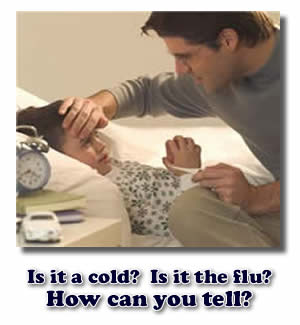
Cold vs Flu Symptoms: These two illnesses are often easily confused because the symptoms are so similar.
As we compare the symptoms of these two common ailments, I think you'll see why we often have trouble making a self-diagnosis.
Having said that, proper identification of the cause of your discomfort can really help you in finding appropriate treatments to both the cold and flu.
Are you sneezing? Feeling feverish? Upset stomach? Congested? Is it a cold? Is it the flu?
These are the questions we ask ourselves when we or someone we love (a child, a spouse, an elderly parent) begins to feel unwell.
Looking at both the similar and conflicting symptoms of a cold or flu virus we can discover some generalizations that may help in making that ID.
Running
a fever (or high temperature) is more common with a bout of the flu,
rather than a cold, although infants with a cold may develop a low grade
fever.
The flu is also associated with body aches and fatigue, but fatigue can also be associated with a cold.
Nasal congestion and sneezing are usually evident in colds while much
less frequently experienced in flu cases. A sore throat is associated
with both colds and flu.
Additionally, chest discomfort due
to cough are often present in flu rather than in colds, but again, it's
not cut and dried. A severe cold can develop into a chest infection on
occasion.
Other common cold symptoms usually include nasal
congestion which is characterize by a feeling of fullness or a "stuffy
nose" and may be accompanied by sneezing. Watery eyes and a scratchy
nose, throat or eyes may be experienced as well.
Headaches and fatigue are associated mostly with the influenza virus.
So, to summarize the comparison between cold vs flu symptoms, here's a little chart to help you out.
Comparing Cold vs Flu Symptoms
Cold Symptoms
Mainly affects head, nose, and throat. |
Flu Symptoms
You can experience symptoms throughout the body. |
|
Fever only in infants and toddlers. |
Sudden onset of fever. |
|
Stuffy and runny nose, sneezing, and sometimes a sore throat. |
Begins with a fever and can be followed by a headache, aches throughout the body, lack of energy, vomiting, and sometimes dizziness. |
|
Cold symptoms begin 1 to 5 days after exposure to one of the 200 cold viruses. The symptoms usually begin with irritation in your nose or a scratchy feeling in your throat. Within hours you may experience sneezing and a runny nose. |
Flu symptoms begin within 1 and 3 days of exposure to one of the many variant flu bug germs - You begin with a fever, tiredness, and muscle aches and pain. This may lead to more severe symptoms like croup, sore throat, bronchitis, ear infection, and pneumonia. |
|
Usually over in a week, but your cough may last longer. |
Depending on the strain of flu virus you get, the duration of the infection will vary. You may experience what is commonly referred to as "the 24 hour flu" but generally symptoms disappear within 4 to 7 days in most cases. However, the cough and tiredness may linger for a few weeks. |
Most common cold vs flu symptoms can be dealt with using remedies
available in most of our homes. Likewise, there are natural vitamins
and herbal medicines which are proven to be beneficial in preventing and
treating cold and flu.
Most people will tell you that
there is "no cure for the common cold." What they really mean is that
there is no conventional medicine that will be a quick fix for the cold
virus. On the other hand, conventional medicine and the pharmaceutical
companies will tell you that prevention of flu can be achieved by
vaccination.
My family and I do NOT get vaccinations
because I believe it's better to strengthen the immune system rather
than inject the virus into the body. You have to determine what is
right for you and your family.
Flu incubation is the period
from infection to the presence of signs and symptoms. The flu
incubation period is between 1 and 4 days. If you know you have been
exposed to someone with the flu, it's a good idea to start taking some
preventive measures.
For me, I immediately begin taking Herbal Fiberblend
for a few days. In fact, this applies to exposure to someone with a
cold, as well. The herbs in HFB are anti-parasitic and anti-bacterial,
and for the last few years (since "discovering" HFB) I have found myself
with very little cold or flu symptoms.
Of course, keeping
your immune system strong is important both before, during, and after a
bout of cold or flu. Increase your nutritional intake by including more
vitamin C, D, and antioxidant supplements. I also like to use the Garden Trio whole food supplement powders for immune support, particularly throughout the cold and flu season.
Although
distinguishing between cold and flu symptoms can be a bit tricky,
protecting and boosting your immune system is always a safe bet.
I hope this little article debating cold vs flu symptoms was helpful to you in determining what your next step will be.
To your good health!
Cold or Flu Question, Comment, or Remedy?
If you've found a particular natural remedy to be helpful in treating or preventing flu or cold symptoms, share them here.
Or maybe you have a question or comment about getting the cold or flu. Feel free to post it here and give other visitors a chance to help or benefit.
Give as many details and specifics as possible in your question or comment.
Return from Cold vs Flu Symptoms to All About Parasites Homepage
Home | Cold vs Flu | 24 Hour Flu | Best Cold Medicine | Swine Flu Vaccine | Swine Flu Precautions | What Is Swine Flu | Swine Flu Facts | Swine Flu Info | Swine Flu Pandemic | Swine Flu Treatment | Swine Flu Symptoms | Swine Flu Shot | Swine Flu Prevention | Swine Flu Epidemic | Causes of Common Cold | Common Cold Remedy | Common Cold Treatment | Flu Complications | Cold MD | Can Dogs Get The Flu? | Flu Shot Ingredients | Flu Shot Reaction | Flu Incubation Period |
Recent Articles


-
Jesus & I share an inside joke
Dec 13, 21 01:49 AM
 I talk to Jesus constantly all day, sometimes thru the spirit, and sometimes we speak aloud. I hear Him clearly. Someone asked me once how do I know
 -
Hair Root Follicle Worms
Oct 22, 21 11:17 PM
I have been suffering from Morgellons since 2003 at that time there was no name for it. I named it hair root follicle worms. It was horrible! I tried -
Natural Parasite Cleansing Protocol
Aug 27, 19 10:48 PM
 This natural parasite cleansing protocol is safe, effective, and has a money back guarantee. You have nothing to lose and everything to gain. Don't worry if everything else has failed, this...
|
|
| Search our Site: |




New! Comments
Have your say about what you just read! Leave us a comment in the box below.